"Physical AI is a transfer claim. The body decides how much of the claim survives."
Section 1.5
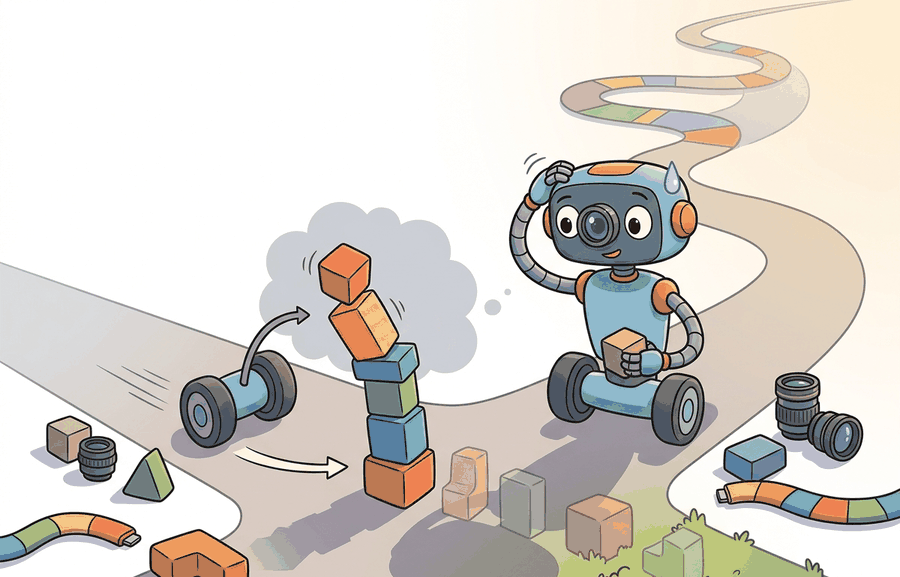
This section builds on the closed-loop instability introduced in section 1.1 and the simulation-versus-reality boundary drawn in section 1.4. The five enablers surveyed here are developed in depth across three later parts: GPU-parallel simulation and sim-to-real transfer in section 17.2 and section 20.1, cross-embodiment data scaling in section 24.3, and low-cost teleoperation pipelines in section 23.2. The VLA model class, the architectural thread that unifies all five, is treated as a first-class topic in section 34.1.
In 2023, a robot arm trained on data from thousands of other robots picked up a coffee cup it had never seen before and placed it precisely where it was asked. No custom policy was written. No engineer tuned gains for that gripper. The model had absorbed motor knowledge from dozens of embodiments and semantic understanding from internet-scale vision-language pretraining, then transferred both into that single closed loop. Between 2023 and 2026, five independent enablers matured at once: GPU-parallel simulation, cross-embodiment datasets, low-cost teleoperation, open foundation models, and cheap hardware. Here you will trace how those five threads converged to turn "one policy per robot" into "one foundation model adapted to this robot," and why the vision-language-action (VLA) architecture is the linchpin holding them together.
What "Physical AI" actually asserts
Strip the term to its load-bearing content and it is a transfer hypothesis. Internet-scale vision-language pretraining produces representations of objects, relations, and instructions that are useful for control; pooled robot data supplies the motor grounding that text and images cannot; and a single network can carry both into a closed loop on a real body. The phrase earns its keep only where it changes what a builder can train, share, adapt, and evaluate. It is not a synonym for placing a large model on a robot, and it does not erase body-specific constraints: a token that means "close gripper" carries different timing, force, latency, and failure modes from one robot to the next. A pretrained prior that survives a benchmark but fails in the loop is not a transferred policy; it is an untested hypothesis waiting for the body to weigh in.
Writing the transfer claim as an equation
Figure 1.5 captures this structure: internet-scale and cross-robot pretraining feed a single VLA policy whose action outputs are tested against a specific body. A compact abstraction makes the transfer claim precise. Write the policy as a shared backbone plus an embodiment-conditioned action interface,
$$a_t = g_\theta\big(\phi_\theta(o_t, l_t),\, e\big),$$
where \(\phi_\theta\) encodes observation \(o_t\) and language context \(l_t\) into a representation, \(g_\theta\) maps that representation to commands, and \(e\) is an embodiment descriptor (gripper, joints, camera frame, control rate, safety limits). The Physical AI bet is that \(\phi_\theta\) transfers broadly across bodies while \(g_\theta\) and \(e\) absorb the body-specific differences. Everything below is about why both halves of that bet became cheaper to make in this window.
The pretrained prior is only a hypothesis until it survives contact. Two policies with identical offline action accuracy can diverge completely in the loop because one was never trained on the states its own errors produce (Section 1.1). Physical AI is the claim that perception, language, action, and embodiment share enough structure to transfer; the closed-loop rollout is what adjudicates it.
The five causal factors behind the 2023-2026 shift
The shift was not one breakthrough. It was five enablers, each with a concrete technical cause, maturing close enough together to compound. The order matters: simulation and pretraining made models trainable, data pooling and cheap teleoperation made them feed-able, and the VLA class gave them a shared form. Figure 1.5A places these enablers on a timeline, mapping the key model releases of 2023-2026 to the robot deployment milestones they unlocked.
(a) GPU-parallel simulation. The cause is mechanical, not conceptual. When the physics step and the policy forward pass both run on the GPU, thousands of environments advance in lockstep without the CPU-GPU copy that throttled earlier simulators. Isaac Gym demonstrated end-to-end GPU simulation, its successor Isaac Lab built a maintained training stack on top, and MuJoCo's MJX brought the same JAX-accelerated batching to a widely trusted contact model. Collecting millions of environment steps per minute yields the headline result directly: a quadruped learns a walking gait in minutes of wall-clock on a single workstation. Concrete numbers make the scale clear, though exact figures vary by task and codebase: reported comparisons are typically not a controlled, apples-to-apples benchmark of the same algorithm on both platforms. A locomotion policy that once needed roughly 50,000 serial rollout episodes on a CPU cluster typically converges in the time it takes to collect a few hundred episodes worth of wall-clock time across 4,096 parallel GPU environments, because every "episode" in the batch contributes gradient signal at once. Part V treats this in depth.
(b) Large multimodal pretraining. Before reading on, guess: how many additional robot demonstrations did RT-2 need before it could follow an instruction it had never seen before? Zero. The cause is architectural. A VLM backbone already encodes the visual and semantic priors a robot needs: object identity, spatial relations, and free-form instruction parsing. A control policy that initializes from one skips the most data-hungry part of perception. RT-2 made this concrete. It co-fine-tuned a PaLI-X 55B encoder-decoder on roughly 130,000 real-robot trajectories. The resulting policy generalized to object categories and natural-language instructions absent from those trajectories, because the backbone had already seen them during web pretraining. The robot arm answered novel phrasings such as "move the extinct animal to the heat source" with no demonstration of that command. The backbone turned language into a spatial target; the fine-tuned action head turned that target into wrist velocity commands at 3 Hz. Pretraining does not solve the temporal constraint: a 55B-parameter forward pass runs at 3 Hz, far too slow for contact-rich tasks that need 100 Hz torque corrections. The VLA class therefore splits into a high-level VLM commanding a low-level reactive controller rather than running one monolithic network at servo rate. The enabler is reuse of expensive perception; the limit is the latency gap between token generation and real-time joint control.
Checkpoint
So far: two of the five enablers are on the table. GPU-parallel simulation (a) makes training cheap by running thousands of environments on the GPU at once; large multimodal pretraining (b) makes semantic understanding free by reusing a VLM backbone instead of learning object and language concepts from robot data alone. Both lower the cost of one half of the transfer bet from the earlier equation, but neither one, by itself, solves the real-time control problem below.
A common misconception is that "Physical AI" means a single large model runs the entire perception-to-torque pipeline in real time, just as a language model generates tokens end to end. This is wrong in contact-rich embodied settings: a 55-billion-parameter forward pass executes at roughly 3 Hz, far too slow for the 100 Hz or higher torque corrections that manipulation and locomotion require. The correct mental model is a two-level architecture: a VLA (or VLM) operates at the semantic level, selecting goals and high-level actions, while a separate fast reactive controller executes those commands at servo rate. Internet-scale pretraining transferred into the semantic layer; it did not eliminate the real-time control layer.
(c) Cross-embodiment data pooling. The cause is that robot data is scarce per platform but abundant in aggregate. Open X-Embodiment and the RT-X models pooled trajectories from many labs and robot types into one corpus and showed positive transfer across embodiments, the first credible evidence for robot-data scaling laws of the kind that drove language models. The enabler is a shared schema: once trajectories from different bodies share a format, more data helps every body rather than only its own.
Why this matters physically: any single platform accumulates demonstrations slowly, because collection ties up hardware, operators, and reset time. A new gripper design may have fewer than a hundred hours of data. Without pooling, the policy must generalize contact and force from that thin base and will fail on unseen object poses. Pooled data from kinematically diverse platforms exposes the shared backbone to far wider visual contexts and grasp geometries, so fine-tuning on the target robot starts from a strong prior rather than scratch.
How it works mechanically: each source dataset is normalized to a common trajectory schema (observation type, action dimension, timestamp) and action spaces are rescaled to a shared range before mixing. The backbone then sees trajectories from arms, quadrupeds, and mobile bases interleaved during pretraining, learning motor abstractions that are not tied to one kinematic chain. At fine-tuning time, the target robot's demonstrations update only the residual difference between the pooled prior and its own body.
Cross-embodiment pooling is essentially the robot equivalent of "eat your vegetables because children elsewhere are starving": morally dubious as parenting advice, but surprisingly effective when the children in question are neural network weights and the vegetables are trajectories from a quadruped you have never met.
(d) Low-cost teleoperation and open hardware. The cause is that the binding constraint on robot learning is high-quality demonstration data, and the cost of collecting it collapsed. ALOHA and Mobile ALOHA showed bimanual fine-manipulation data collected on affordable hardware; GELLO gave a low-cost leader-arm teleoperation interface; UMI captured in-the-wild manipulation data with handheld grippers, decoupling data collection from the robot itself. The LeRobot open stack then standardized datasets, training, and deployment so that a small team can record, train, and evaluate without rebuilding the plumbing. The enabler is throughput per dollar of demonstrations.
(e) The VLA model class. The cause is architectural unification: RT-2, OpenVLA, Octo, and pi-0 collapse perception, language, and action into one network that emits motor commands, replacing the older pipeline of separate perception, planning, and control modules. This is what makes (a) through (d) interoperable, since one model form can consume VLM priors, ingest pooled cross-embodiment data, and be fine-tuned on cheap demonstrations. The enabler is a common interface that the other four can all feed.
How they compound. Parallel simulation makes a policy trainable at low cost; VLM pretraining gives it semantic priors for free; pooled data and cheap teleoperation supply the motor grounding; and the VLA form lets all of these enter one model that fine-tunes onto a new body. Each enabler lowers the cost of exploiting the others, which is the signature of a compounding regime rather than a single advance. Part VII follows the trajectory into deployment, where the compounding meets its limits. That same compounding, though, also lowers the cost of producing a convincing demo, which is why the next caution is about telling a measured result apart from a polished one.
Think of a kitchen that gains a sharp knife, a reliable oven, a stocked pantry, and a timer all in the same month. Any one tool helps a little, but the knife makes prep faster, which means you use the oven more often, which empties the pantry faster, which justifies restocking it with better ingredients, and the timer lets you run two dishes at once. None of these gains exists in isolation: each one raises the ceiling on what the others can accomplish. The 2023-2026 enablers worked the same way. Cheaper simulation meant you could afford to train bigger models; bigger models made pooled cross-embodiment data worth collecting; cheaper teleoperation filled that pool faster; and the VLA architecture gave all of it a single place to land. Remove any one ingredient and the others still help, but the ceiling drops sharply.
Be precise about evidence class. The simulation, pretraining, data-pooling, and VLA results above are peer-reviewed and, in most cases, reproduced on open code and data. Many of the most visible humanoid manipulation and locomotion clips from this window are vendor-produced demonstrations: edited footage, undisclosed teleoperation or scripting, hand-picked takes, and no reported success rate over an independent trial set. A polished demo is a feasibility signal, not a reliability measurement. Treat any claim without a reported success rate, trial count, and reset protocol as unreplicated until shown otherwise, and never let a demo stand in for a benchmark.
Algorithm: Physical AI Transfer Feasibility Checklist
Input: A candidate VLA policy \(\pi_\theta\) with shared backbone \(\phi_\theta\), target embodiment \(e'\) (end effector, joint count, control rate \(\Delta t\), force limits), and a demonstration dataset \(\mathcal{D} = \{(o_t, l_t, a_t)\}\)
Output: Transfer decision \(d \in \{\text{full-stack}, \text{representation-only}, \text{retrain}\}\) and a minimum evidence requirement list
- Identify transferred layers. Record which components are reused from \(\pi_\theta\): backbone \(\phi_\theta\) only, action head \(g_\theta\) only, or both. A shared \(\phi_\theta\) with a new \(g_\theta\) is representation-only transfer; using both is full-stack transfer.
- Check embodiment descriptor coverage. Verify that \(e'\) (gripper type, joint limits, \(\Delta t\)) was represented in the pretraining corpus. If \(e'\) is out-of-distribution, flag \(g_\theta\) as unvalidated and require re-adaptation before any deployment claim.
- Compute distribution shift \(\delta\). Estimate \(\delta = \|\mu_{\mathcal{D}'} - \mu_{\mathcal{D}}\|\) over observation features. If \(\delta\) exceeds a chosen threshold \(\tau\), freeze the backbone (\(\phi_\theta\) fixed) and train only \(g_\theta\) on \(\mathcal{D}'\) to prevent catastrophic forgetting (the failure mode where fine-tuning on new data overwrites the pretrained representations instead of adding to them, so the model loses capabilities it had before fine-tuning began) of pretrained representations.
- Size the fine-tuning set. If \(|\mathcal{D}'| \ge N_{\min}\) (typically 200 episodes for full fine-tuning, 50 for head-only), unfreeze \(\phi_\theta\); otherwise keep \(\phi_\theta\) frozen and set learning rate \(\alpha_{\text{head}} \gg \alpha_{\text{backbone}}\).
- Run closed-loop rollouts on source embodiment. Confirm baseline success rate \(S_{\text{src}}\) before any transfer. This anchors which competencies were genuinely present versus assumed.
- Fine-tune and measure \(S_{\text{tgt}}\) on \(e'\). Co-compute \(S_{\text{tgt}}\) and \(S_{\text{src}}\) in one evaluation pass on the same checkpoint. A drop in \(S_{\text{src}}\) after fine-tuning signals catastrophic forgetting; stop and revert if \(S_{\text{src}}\) falls more than \(\epsilon\) below baseline.
- Attribute the performance gap. For each failure mode, classify root cause as: (i) perception failure (\(\phi_\theta\) did not recognize the target), (ii) action failure (\(g_\theta\) issued wrong motor commands for \(e'\)), or (iii) timing failure (control loop latency \(\Delta t\) mismatched). Never report a blended \(S_{\text{tgt}}\) without this attribution.
- Separate demo evidence from replicated results. For every cited result, check whether a success rate \(S\), trial count \(N\), and reset protocol \(R\) were reported. Assign evidence class: peer-reviewed (published, reproducible on open code and data), vendor demo (footage or press release with no \(S\), \(N\), \(R\) reported), or internal (your own team's unpublished run, reported with \(S\), \(N\), \(R\) but not yet independently reproduced). Vendor demos with no \(S\), \(N\), \(R\) do not count as evidence of \(\nabla_\theta\)-level generalization.
- Decide transfer class. If \(S_{\text{tgt}} \ge S_{\min}\), both \(\phi_\theta\) and \(g_\theta\) generalized: return \(d = \text{full-stack}\). If only perception tasks pass: return \(d = \text{representation-only}\). If neither: return \(d = \text{retrain}\) and surface the minimum dataset size and architecture change required.
- Document the enabler dependency. Record which of the five enablers (GPU-parallel simulation, multimodal pretraining, cross-embodiment data, cheap teleoperation, VLA model class) the decision relies on, so future comparisons can be made against the same causal assumptions.
Step-Through: the Transfer Feasibility Checklist on a suction-gripper move
Trace the checklist from earlier in this section with concrete numbers. Start with an OpenVLA-style policy pretrained on RT-X data, target embodiment \(e'\) = suction gripper at a control rate \(\Delta t = 50\) ms (20 Hz), and a new dataset \(\mathcal{D}'\) of 60 episodes. Step 1: components reused = backbone \(\phi_\theta\) only (new \(g_\theta\) for suction), so this is representation-only transfer. Step 2: suction grippers were absent from the pretraining corpus, so flag \(g_\theta\) unvalidated. Step 3: distribution shift \(\delta = \|\mu_{\mathcal{D}'} - \mu_{\mathcal{D}}\| = 0.42\), above the threshold \(\tau = 0.30\), so freeze \(\phi_\theta\). Step 4: \(|\mathcal{D}'| = 60 < N_{\min} = 200\), so keep the backbone frozen and set \(\alpha_{\text{head}} = 1\!\times\!10^{-3} \gg \alpha_{\text{backbone}} = 0\). Step 5: baseline source success \(S_{\text{src}} = 0.88\). Step 6: after head-only fine-tuning, measure on the same checkpoint \(S_{\text{tgt}} = 0.34\) and re-check \(S_{\text{src}} = 0.86\) (drop of 0.02, within \(\epsilon = 0.05\), so no catastrophic forgetting). Step 7: attributing the 0.54 gap, 0.40 traces to action failures (suction physics) and 0.14 to timing (the 20 Hz loop). Step 9: \(S_{\text{tgt}} = 0.34 < S_{\min} = 0.70\) but perception tasks pass, so return \(d = \text{representation-only}\). The number that matters is not the headline 0.34; it is that perception held while control did not.
Enabler to capability to system
The table maps each causal factor to the capability it unlocked and a representative, citable system. Years are first public release of the named artifact.
| Enabler | Capability unlocked | Representative system (year) |
|---|---|---|
| GPU-parallel simulation | Thousands of parallel environments; minutes-scale RL training of locomotion and contact-rich skills | Isaac Gym (2021) to Isaac Lab; MuJoCo MJX (2023) |
| Large multimodal pretraining | Semantic priors (objects, instructions, relations) transferred into action selection | RT-2 (2023) |
| Cross-embodiment data pooling | Positive transfer across robot types; early robot-data scaling evidence | Open X-Embodiment / RT-X (2023) |
| Low-cost teleoperation and open hardware | Affordable high-quality demonstration data; reproducible data-to-deploy workflows | ALOHA / ACT (2023); LeRobot (2024) |
| The VLA model class | One network mapping image and language context to motor commands | OpenVLA (2024); pi-0 (2024) |
OpenVLA is a concrete, open instance of the VLA class: a vision-language backbone with an action head, fine-tunable on robot demonstrations. LeRobot supplies the surrounding infrastructure, dataset formats, training recipes, and evaluation plumbing, so a team can reproduce the data-to-deploy path rather than rebuild it. The shortcut is not that physical action becomes easy; it is that the shared machinery lets a team spend its effort on the task contract and the failure cases instead of the loader and the trainer (Part V).
When fine-tuning OpenVLA on a new robot, the default training script sets --freeze_vision_backbone False, meaning the full model including the SigLIP vision encoder (a contrastively pretrained image-text backbone that supplies OpenVLA's visual features) is updated. If your demonstration set is under roughly 200 episodes, freezing the backbone with --freeze_vision_backbone True and training only the action head and language projector typically prevents catastrophic forgetting of the pretrained visual representations, which is the most common source of silent performance collapse on out-of-distribution lighting and object poses. Unfreeze the backbone only after confirming that the action head alone has plateaued on your held-out rollout success rate.
An audit that separates representation transfer from control transfer
Having a shared model form and open tooling makes transfer cheap to attempt, but cheap attempts are exactly what make a disciplined audit necessary. The discipline a Physical AI claim demands is to say which layer transferred. A model can recognize the object and parse the instruction across two robots while still failing on contact, timing, or force. The snippet below records that distinction explicitly: a result that keeps the encoder but swaps the action head is a representation-only transfer and should be reported as such, not as evidence that the whole policy generalized.
# Classify a transfer result by which layer was actually reused.
# Representation reuse without control reuse is a weaker claim than it looks.
runs = [
    {"robot": "arm_a",      "shared_encoder": True, "shared_action_head": True},
    {"robot": "arm_b",      "shared_encoder": True, "shared_action_head": False},
    {"robot": "suction_bot","shared_encoder": True, "shared_action_head": False},
]

def transfer_class(row):
    if row["shared_encoder"] and row["shared_action_head"]:
        return "representation_and_control"
    if row["shared_encoder"]:
        return "representation_only"  # body changed the action semantics
    return "no_shared_layer"

for row in runs:
print(f'{row["robot"]:>12}: {transfer_class(row)}')transfer_class function classifies each run by whether the encoder, the action head, or both were reused: it carries no performance numbers on purpose, it forces the reader to name the transferred layer before discussing success rates, so a representation-only result is never quietly upgraded to a full-stack transfer claim.Two gaps recur. First, a benchmark number (offline action accuracy, simulated success rate) can be high while on-robot reliability is low, because the offline distribution does not contain the off-distribution states the policy reaches once it controls the loop (Section 1.1). Second, a demo gap: a curated clip shows the best take, while deployment must hold up over thousands of unscripted episodes with resets, novel objects, and lighting. Always pair any headline number with a closed-loop measurement co-computed on the same checkpoint, and read demos as existence proofs, not reliability claims.
A team moves a VLA policy from a two-finger gripper to a suction gripper. The vision-language backbone transfers, so the policy still locates and names the target. The action head, contact model, and failure labels do not transfer, because suction succeeds and fails on different physics. A credible report attributes the retained competence to shared perception and the dropped competence to the new end effector, rather than reporting one blended success number that hides which layer moved.
The most common misapplication of the Physical AI framing is treating representation transfer as full-stack transfer. A team pretrained on RT-X data and fine-tuned on fifty gripper demonstrations achieves 85% success in their lab setup, then redeploies the same checkpoint to a warehouse with different lighting, a suction cup instead of a parallel-jaw gripper, and a 20 ms higher control-loop latency. Success rate drops to under 30%. The backbone still recognizes the target object correctly; the failure lives in the action head, which was calibrated to gripper-contact dynamics that do not apply to suction. The Physical AI framing does not prevent this failure; it only provides the vocabulary to diagnose it. When a VLA policy degrades on a new body, the first question is always: which layer moved and which layer was silently assumed to carry over?
The enablers got models onto robots; they did not make the loop reliable. Three active directions are defining the 2024-2026 frontier.
Diffusion and flow-matching action heads. Flow-matching (a training method that learns to transform random noise into a target distribution through a smooth, continuous path, closely related to diffusion models) generates a full continuous action, rather than picking one of a fixed set of discrete motion tokens. Replacing the discretized token prediction of early VLAs with continuous generative models of the action distribution was, as of 2024-2025, the fastest-moving architectural thread. pi-0 (Black et al., 2024, Physical Intelligence) demonstrated that a flow-matching head over a frozen VLM backbone reaches contact-rich dexterity that autoregressive token heads could not; subsequent work extended the idea to whole-body humanoid control. The open problem is matching the expressiveness of these models to high-frequency servo rates without sacrificing the semantic grounding of the pretrained backbone.
Scalable real-world RL and online data collection. Parallel simulation provides near-free synthetic data, but the highest-value learning signal, on-robot closed-loop experience, is still slow and expensive. The RoboCasa benchmark (ARISE Initiative / UT Austin, 2024) and the DROID large-scale in-the-wild dataset (Stanford / Berkeley, 2024) represent two complementary bets: richer simulation diversity versus broader real-world coverage. Neither has closed the gap between simulated and real success rates on unscripted long-horizon tasks, and principled online RL directly from real robot rollouts at the scale of language-model fine-tuning remains unsolved.
Long-horizon task reliability and failure recovery. Chaining sub-tasks under compounding closed-loop error (Section 1.1) without drift or unrecoverable states is brittle in every current VLA. PhysicalBench (MIT CSAIL, 2025) formalized the evaluation gap: aggregate success rates on short pick-and-place tasks do not predict performance on five-step household tasks. Recovery policies, state estimators that detect failure before it compounds, and hierarchical planners that can replan mid-task without full resets are all active open areas.
Open problem for a PhD student. Certifying tail behavior of a VLA policy is unsolved: given a fine-tuned checkpoint and a deployment specification (object set, lighting envelope, reset protocol), what is the tightest achievable bound on the probability of catastrophic failure over 1,000 unscripted episodes, and can that bound be computed without running all 1,000 episodes? Conformal prediction, PAC-Bayes bounds adapted to sequential decision-making, and adversarial environment generation are candidate tools, but none yet scales to the observation spaces and action frequencies of real VLA deployments.
Real-World Application: warehouse manipulation at Physical Intelligence
Physical Intelligence's pi-0 model is a working instance of the full five-enabler stack: a VLM backbone (multimodal pretraining) is fine-tuned on pooled cross-embodiment robot data and emits actions through a flow-matching head (the VLA model class), with demonstrations gathered via low-cost teleoperation. In 2024 the same checkpoint drove distinct robot bodies on dexterous tasks such as folding laundry and bussing tables. The Physical AI claim is exactly what makes this economical: one pretrained policy is adapted per body rather than written from scratch for each.
Lab: measure where representation transfer ends and control transfer begins
Goal: empirically reproduce the representation-versus-control split that this section argues is the core of any Physical AI claim, by watching a pretrained backbone hold while an action head fails on a changed body.
Tools: Python with the LeRobot stack and a published OpenVLA checkpoint, or, if no GPU is available, a MuJoCo / Gymnasium proxy (FetchPickAndPlace-v2) with a small behavior-cloning policy split explicitly into a frozen feature encoder and a trainable action head.
What to vary: (1) freeze versus unfreeze the vision backbone during fine-tuning; (2) the size of the fine-tuning demonstration set (sweep 20, 50, 100, 200 episodes); (3) one embodiment-level change between train and test, for example end-effector geometry, friction, or control-loop rate.
What to observe: log two numbers on the same checkpoint each run, a perception probe (can the model still localize and name the target object) and closed-loop task success on the changed body. You should see the perception probe stay roughly flat across the embodiment change while task success drops, and you should find the episode count at which unfreezing the backbone starts to help rather than trigger catastrophic forgetting. That crossover point, plotted against demonstration-set size, is the empirical signature of the transfer claim. Budget 15-30 minutes once the checkpoint and dataset are downloaded.
The 2023-2026 shift was five enablers compounding, GPU-parallel simulation, multimodal pretraining, cross-embodiment data pooling, cheap teleoperation with open tooling, and the VLA model class, not a single breakthrough or a slogan. The framing is useful exactly when it states which layer transfers across bodies and which must be re-adapted, and it earns trust only through closed-loop evidence rather than curated demonstrations.
Take a recent embodied AI system announced in the last year (an open VLA release, a humanoid demonstration, or a manipulation result). Classify it by which of the five enablers it actually depends on: GPU-parallel simulation, multimodal pretraining, cross-embodiment data pooling, low-cost teleoperation and open hardware, or the VLA model class. For each enabler you mark as load-bearing, cite the specific evidence in the source. Then separate what is a demonstrated, replicated result from what is a vendor demo with no reported success rate, trial count, or reset protocol, and state which single piece of missing evidence would most change your confidence.
Project Ideas
Beginner (weekend): Train a locomotion policy in MuJoCo (using the Ant-v4 or HalfCheetah-v4 Gymnasium environment) with a standard PPO (Proximal Policy Optimization) implementation from Stable-Baselines3, then swap the reward function to produce a qualitatively different gait; the key challenge is understanding why the same network architecture produces brittle policies when the reward signal changes even slightly. Intermediate (1-2 weeks): Use Isaac Lab to train a pick-and-place policy in GPU-parallel simulation on thousands of randomized object poses, then evaluate the same checkpoint in PyBullet with different lighting and friction parameters; the key challenge is diagnosing which fraction of the success-rate drop comes from visual distribution shift versus contact-model mismatch, which is the sim-to-real transfer problem in miniature. Intermediate (1-2 weeks): Fine-tune OpenVLA on a small LeRobot-format demonstration dataset (50-100 episodes) collected via a low-cost teleoperation setup or a simulated environment, comparing a frozen-backbone run against a full-model fine-tune; the key challenge is reproducing the catastrophic forgetting pattern described in this section and finding the episode count at which unfreezing the backbone starts to help rather than hurt.
What's Next?
Section 1.6 grounds the framing in examples from vacuums, drones, vehicles, manipulators, humanoids, and game agents.
Section References
Kim, M. J. et al. "OpenVLA: An Open-Source Vision-Language-Action Model." (2024). https://arxiv.org/abs/2406.09246
Enabler (e). An open, reproducible VLA: vision-language backbone plus an action head, fine-tunable on demonstrations. Used here as the concrete study case for layer-by-layer transfer.
Black, K. et al. "pi-0: A Vision-Language-Action Flow Model for General Robot Control." (2024). https://arxiv.org/abs/2410.24164
Enabler (e). A flow-matching action head over a VLA backbone, representative of the high-frequency-control direction in the VLA class.
Hugging Face. "LeRobot: state-of-the-art machine learning for real-world robotics in PyTorch." (2024). https://github.com/huggingface/lerobot
Enabler (d), infrastructure. Open-source software project (not peer-reviewed); standardizes dataset formats, training, and deployment so the data-to-deploy path is reproducible.
Open X-Embodiment Collaboration. "Open X-Embodiment: Robotic Learning Datasets and RT-X Models." (2023). https://arxiv.org/abs/2310.08864
Enabler (c). Pools trajectories across many robot types into one corpus and shows positive cross-embodiment transfer, the first credible evidence for robot-data scaling.
Brohan, A. et al. "RT-2: Vision-Language-Action Models Transfer Web Knowledge to Robotic Control." (2023). https://arxiv.org/abs/2307.15818
Enablers (b) and (e). Co-fine-tunes a VLM on robot trajectories, demonstrating that web semantics carry into action selection.
Zhao, T. Z. et al. "Learning Fine-Grained Bimanual Manipulation with Low-Cost Hardware (ALOHA / ACT)." (2023). https://arxiv.org/abs/2304.13705
Enabler (d). Affordable bimanual teleoperation hardware plus the ACT policy, an anchor for the collapse in demonstration-collection cost.