"When the model becomes the engine, compounding error stops being abstract: it shows up as controls that lose their meaning."
A World Model That Tries To Replace The Engine
Imagine running DOOM entirely inside a neural network: no game engine, no physics rules, just a diffusion model hallucinating each frame from the last, as sketched in Figure 39.5A. That is exactly what GameNGen achieved in 2024, and Oasis (a publicly playable, open-world neural Minecraft with no underlying game code, built by Decart and Etched) pushed the same idea into open-ended interactive worlds. For embodied AI, this shift is pivotal right now: if a model can sustain a playable, action-responsive environment in real time, robots and agents can rehearse inside generated experience at massive scale without a single physics simulator. Here you will stress-test both systems, measure where compounding error breaks controllability, and understand what neural game engines still need before they can serve as reliable training substrates.
Compare the two systems through the lens of controllability and substrate. GameNGen shows a diffusion-based neural engine for a classic game; Oasis shows an interactive generated world that exposed both the promise and instability of frame-by-frame generative environments.
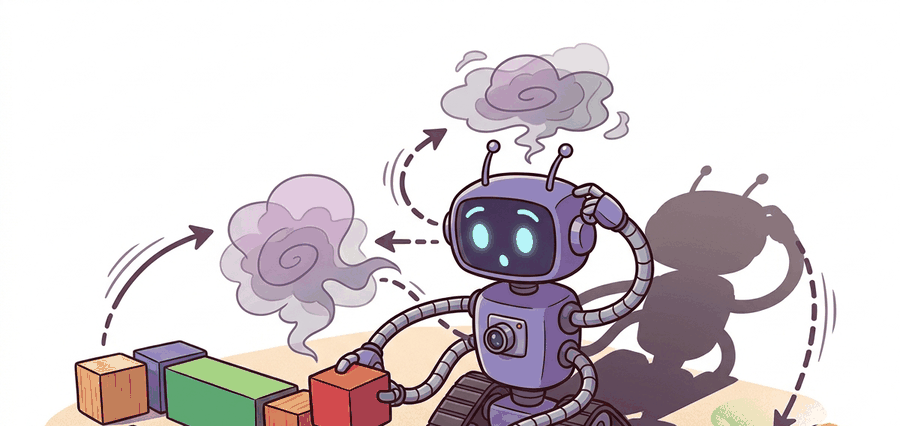
When the model becomes the engine, compounding error stops being abstract. It shows up immediately as broken affordances, drifting map logic, or controls that lose their meaning.
Problem First
What happens when you fire a rocket down a DOOM corridor and there is no corridor, no rocket, and no physics anywhere in the loop, only a network guessing the next frame from the last? Neural game engines matter because that setup reveals what breaks when the model itself must sustain interactive dynamics in real time, not merely continue a clip or produce synthetic training data offline.
Core Model
GameNGen models an interactive environment by predicting the next frame conditioned on past frames and actions, then reusing its own output autoregressively. The challenge is compounding error: $$o_{t+1} \sim p_\theta(o_{t+1} \mid o_{\le t}, a_t), \qquad o_{t+k} \text{ depends on generated } o_{t+1:t+k-1}.$$ Every small artifact can become part of the state the next step conditions on.
For embodied AI, compounding error is not just a visual nuisance. A robot policy trained inside a neural engine learns affordances from synthesized observations. When the engine drifts, the policy learns that a surface is graspable or a corridor is passable under conditions that never exist on real hardware. To put the stakes in scale terms: a physics simulator can typically generate tens of thousands of training episodes overnight for free, while collecting comparable diversity on real hardware typically costs months of robot time and only on the order of a few hundred real episodes before wear and logistics force a stop, so even a neural engine that drifts after 200 steps can still be a useful amplifier, provided its early frames stay physically valid. That false confidence transfers directly to physical failures: joint limit violations, missed grasps, or navigation into walls.
The propagation mechanism works because the model receives its own previous output as input. Each generated frame carries small inaccuracies; the model treats those inaccuracies as ground truth when generating the next frame. Errors accumulate multiplicatively rather than averaging out, so in practice a 0.5% per-frame pixel error can become a visibly shifted scene within dozens of steps rather than staying bounded (see the step-through walkthrough below for a worked example of this growth curve). The diagram below traces this loop: the diffusion model (a generative model that produces an image by iteratively denoising random noise into a coherent frame) takes the action plus past frames as input, emits a new frame that may contain an artifact, and that same frame is fed straight back as conditioning for the next step.
Checkpoint
So far: a neural game engine feeds its own generated frame back in as the next step's input, so small artifacts are treated as ground truth and compound multiplicatively rather than averaging out, and this matters for embodied AI because a robot policy trained on that drifting output learns affordances that do not hold on real hardware.
Think of a cook who tastes their own sauce at every step and adjusts based only on what they just produced. A pinch of extra salt goes into the pot, the next taste detects "slightly salty" and the cook corrects toward bland, then overcorrects, then corrects again. Each adjustment is anchored to the last output rather than the original recipe, so tiny deviations spiral outward instead of canceling. After twenty such cycles the sauce bears no resemblance to the intended dish, even though each individual correction seemed perfectly reasonable at the time. A neural engine drifts the same way: each generated frame is the "sauce" the next step tastes, so a small visual artifact in frame ten becomes the assumed ground truth for frame eleven, and the accumulated divergence is geometric, not gradual.
That spiraling sauce is not a hypothetical; it is exactly the failure mode the first published neural game engine had to confront head-on. The GameNGen paper is important because it reports real-time interactive simulation of DOOM with a diffusion model and foregrounds long-trajectory stability as a central technical hurdle. Oasis, first framed as a generated game world and more recently extended toward physical-AI uses, exposed the same phenomenon publicly: interactivity is compelling, but state drift and inconsistency quickly become visible when the model is the engine.
The lesson for embodied AI is that real-time generation pressure is informative. It reveals whether the model's internal state is robust enough to support long action loops rather than just short cinematic continuations. A neural engine that holds together for three seconds of gameplay but unravels at second four is not a simulator: it is a convincing opening scene.
Consider a specific case. GameNGen simulates interactive DOOM at roughly 20 frames per second on a single TPU (tensor processing unit, a specialized accelerator chip for the matrix-multiplication workloads that neural networks run). Each frame is conditioned on the previous 3.2 seconds of frames plus the current action. A 10-second session therefore requires the model to generate 200 frames autoregressively, and each generated frame feeds back as conditioning context for the next. Small per-frame artifacts compound across all 200 steps. The reported PSNR (peak signal-to-noise ratio, a decibel measure of how closely a generated frame matches a reference frame, where higher is more faithful) of around 29.4 dB is competitive with lossy video compression. That sounds reassuring, but a 1-dB average drop over 200 frames can correspond to geometry that has migrated several tiles by the time the agent reaches a corridor.
Run repeated user or agent actions through the model in real time, track whether identities, map structure, and action semantics remain stable, and count how long the world remains playable before semantic drift or catastrophic resets appear.
Minimal Probe
The probe below measures playable horizon. It counts how many interactive steps remain semantically valid before the neural engine drifts out of the task manifold.
# Count how long a neural game engine remains semantically valid.
# Horizon matters more than one impressive generated screenshot.
validity = [1, 1, 1, 1, 0, 0]
playable_horizon = validity.index(0)
survival_rate = sum(validity) / len(validity)
print({"playable_horizon": playable_horizon, "survival_rate": round(survival_rate, 2)})
{'playable_horizon': 4, 'survival_rate': 0.67}
Expected behavior: The model remains semantically valid for four steps before drift appears. That is the relevant operational metric for an interactive engine, because the first few frames may look convincing even when the loop is already unstable.
Step-Through: compounding error across a 5-frame loop
Trace how a per-frame error grows when each generated frame is fed back as input. Assume a multiplicative error growth of 1.6x per step (a small artifact makes the next frame slightly harder to render correctly, which enlarges the next artifact), starting from a tiny 0.5% pixel error, and say the world becomes "semantically invalid" once the accumulated error crosses 5% (geometry has migrated more than a tile). Frame 0: error = 0.50% (valid). Frame 1: 0.50 x 1.6 = 0.80% (valid). Frame 2: 0.80 x 1.6 = 1.28% (valid). Frame 3: 1.28 x 1.6 = 2.05% (valid). Frame 4: 2.05 x 1.6 = 3.28% (valid). Frame 5: 3.28 x 1.6 = 5.24% (invalid, crosses 5%). So the playable horizon here is 5 steps. Notice the gap between frames widens each step: the jump from frame 4 to frame 5 (1.96 percentage points) is larger than the entire error at frame 2. That accelerating gap is exactly why "looks fine for the first second" tells you almost nothing about second four.
A playable horizon of four steps before the world starts lying to you sounds discouraging, but consider that plenty of real games have shipped with fewer coherent steps than that. The difference is that a buggy game engine at least keeps the floor in the same place.
There is not yet a single stable, open, plug-and-play neural-engine library that erases all of this complexity. The practical shortcut is to use the official GameNGen project materials or the Oasis project page as reference implementations, then wrap them in your own horizon and controllability harness rather than treating the demo itself as the benchmark.
When adapting GameNGen-style diffusion engines to a new game or environment, the single most impactful parameter to tune first is the frame-buffer length (the number of past frames fed as conditioning context). The published DOOM experiments use roughly 64 past frames (3.2 seconds at 20 fps); cutting this to 16 or fewer dramatically accelerates semantic drift during sharp turns and room transitions, while doubling it to 128 adds memory pressure with diminishing stability returns beyond scene-change boundaries. A practical heuristic: set the buffer to at least the longest uninterrupted action sequence in your training data, then measure playable horizon with a fixed action script before running any policy experiments.
Drift is not uniform across a session: it accelerates at decision points. When an agent takes an action that changes scene content sharply (opening a door, turning 90 degrees, picking up an object), the model must synthesize a new region it has never rendered in that exact context. Diffusion-based engines like GameNGen handle this by conditioning on a fixed-length frame buffer; if the buffer window is shorter than the action's causal reach, the model loses the context it needs to render the new region consistently. Transformer-based engines like Oasis carry a longer token history but pay a quadratic attention cost, so in practice they are truncated too. The practical implication: drift happens fastest during high-action-density phases, not during idle observation, which is also when accurate simulation matters most for policy training.
Practical Recipe
- Report playable horizon explicitly.
- Store action traces next to generated clips so replay can reveal whether drift was visual, semantic, or control-related.
- Measure control lag, because real-time feel is part of the engine claim.
- Use neural engines for stress testing and representation research before trusting them as full control simulators.
A common assumption is that because GameNGen and Oasis produce visually convincing, action-responsive frames, they are ready to serve as training environments for embodied robot policies, the same way a physics simulator like MuJoCo or Isaac Lab would. This is wrong in the embodied AI context because visual plausibility and physical validity are entirely different properties. A neural engine can render a believable corridor while silently drifting the floor geometry, removing contact surfaces, or inverting the semantics of an action, all without any visible discontinuity in a short clip. A policy trained inside such an engine learns affordances from a world that does not exist, and that false confidence transfers directly to physical failure on real hardware. In practice, the more reliable mental model is that neural game engines are stress-testing and representation-research tools with a finite playable horizon, not drop-in replacements for physics-grounded simulators, at least until contact fidelity and long-horizon semantic consistency are further improved.
Real-time interactivity can make weak models look stronger than they are because the early frames are impressive. Always score playable horizon, not only first-frame fidelity or short clips.
An embodied-navigation researcher can use a neural engine to explore how an agent reacts to unusual corridor layouts or moving distractors. That is valuable for stress testing. It is different from using the engine as the sole truth source for collision-rich control, because one semantic glitch in the generated world can invalidate the policy lesson.
Real-World Application: open-world game generation (Decart Oasis)
Decart and Etched deployed Oasis as a publicly playable neural Minecraft that generates each frame from the player's keyboard and mouse input at around 20 fps, with no underlying game code. It became the most visible demonstration of a model-as-engine, and the same compounding-error horizon analyzed here is exactly what players hit when the terrain reshuffles after they look away and turn back.
Direction 1: Scaling neural engines to open-world and physically grounded settings. The 2024 Oasis release (Etched / Decart) demonstrated that transformer-based token-prediction (treating each frame as a sequence of discrete visual tokens and predicting the next one, the same next-token mechanism language models use for text) can sustain interactive Minecraft at 20 fps, but semantic consistency collapses beyond a few hundred steps. Google DeepMind's Genie 2 (2024) pushed further by conditioning a latent-action model (a model that infers an implicit action space directly from video, rather than requiring labeled controller inputs) on a single image to generate diverse 3D-navigable environments; the open problem is extending the playable horizon from seconds to minutes without exponential context cost.
Direction 2: Action-conditioned video generation as a robot policy substrate. Models such as UniSim (Yang et al., 2024, Google) and IRASim (Bu et al., 2024) frame neural engines as action-conditioned video generators that a downstream policy queries instead of a physics simulator. The key remaining gap is contact fidelity: a 20 fps frame generator cannot represent the sub-millisecond collision events that determine grasp success, so policies trained inside these engines accumulate false confidence about affordances that do not survive hardware transfer.
Direction 3: Efficient persistent state for long-horizon engine stability. Sora (OpenAI, 2024) and related consistency-regularized diffusion models showed that enforcing 3D-consistent scene representations inside the latent space dramatically reduces temporal drift. Research groups at CMU and MIT are now adapting these consistency constraints specifically to action-responsive engines rather than passive video generation, targeting drift rates below one semantic event per 500 frames.
Open problem: None of the current neural engines expose a differentiable interface for contact forces. A student who can design a hybrid architecture where a lightweight analytic contact model (rigid-body impulse solver) is tightly coupled into the denoising loop, so that the diffusion model conditions each frame on physically valid contact normals and forces, would unlock the first neural engine that could plausibly substitute for MuJoCo in dexterous manipulation training. The open question is how to backpropagate through the contact solver without abandoning real-time throughput.
For interactive world models with stronger platform ambitions, continue to Section 39.4. For evaluation methodology, jump ahead to Section 39.7. For model-based control in compact latent spaces rather than fully generated frames, compare with Section 38.5.
Beyond the open research directions above, the deeper reason these systems belong in a course at all is pedagogical. These systems are educational because they expose compounding error in the most intuitive possible way: the world stops making sense. In a benchmark table that may appear as a fidelity drop. In an interactive engine it appears as broken affordances, shifting geometry, or controls that stop meaning the same thing across time.
The public fascination with Oasis was therefore scientifically useful. It showed many people, very quickly, what researchers already know: when a generative model becomes the environment, persistence and action semantics become the whole game.
Project Ideas
Beginner (weekend): Build a playable-horizon benchmarking harness for the publicly released Oasis checkpoint using Gymnasium as the action-loop interface; the key challenge is writing a deterministic action script that replays the same sequence across runs so you can compare horizon lengths under different frame-buffer sizes. Intermediate (1-2 weeks): Implement a hybrid neural-physics engine that routes contact events through PyBullet for collision resolution while a lightweight diffusion decoder renders visual frames on top; the key challenge is synchronizing the physics state and the generative model's conditioning context at every step without accumulating position drift. Intermediate (1-2 weeks): Train a navigation policy in a GameNGen-style neural engine built on a small Gymnasium gridworld, then transfer it to a PyBullet environment and measure how much semantic drift in the engine degrades zero-shot transfer; the key challenge is designing affordance probes that distinguish visual drift from physically incorrect contact surfaces.
Lab: measure a playable horizon with an action-conditioned video model
Goal: empirically observe how fast a frame-by-frame generative model drifts when fed its own output, without needing a TPU or the full GameNGen checkpoint.
Tools: Python, PyTorch or diffusers, and any small action-conditioned or image-to-video model you can run locally (for example a Stable Video Diffusion checkpoint from Hugging Face, or a lightweight latent video model). A single consumer GPU is enough; even CPU works if you accept slow frames.
Steps: Generate one frame, then feed that generated frame back as the conditioning image for the next generation, looping 30 to 60 times to build a fully autoregressive rollout. Compare each generated frame against frame 0 with a structural metric (SSIM, structural similarity index, a score between 0 and 1 measuring how well two images match in luminance, contrast, and structure, where 1 means identical, or PSNR) and against the previous frame to track per-step change.
What to vary: the conditioning buffer length (feed back the last 1 frame vs the last 4 frames), the denoising step count, and whether you re-inject a fixed reference frame every K steps.
What to observe: the step index where SSIM-vs-frame-0 drops below a threshold (say 0.5) is your playable horizon. You should see horizon lengthen as buffer length grows and as periodic reference re-injection is added, directly reproducing the buffer-length tuning intuition from the Tip box above.
What is the difference between a neural game engine that looks convincing for ten seconds and one that is reliable enough to support agent research or safety evaluation?
Neural game engines are the sharpest stress test for generative world models because compounding error becomes immediately visible as broken interactivity.
Design a replay artifact for a neural engine benchmark. Which fields would you save so another researcher could diagnose whether failure came from control lag, semantic drift, or object-identity collapse?
Bibliography & Further Reading
Primary References And Tools
Valevski, D. et al.. "Diffusion Models Are Real-Time Game Engines." (2024). https://arxiv.org/abs/2408.14837
GameNGen is the primary academic reference for a real-time neural engine.
GameNGen Project Page. https://gamengen.github.io/
The project page is useful for demonstrations and reported metrics.
Oasis Project Page. https://oasis-model.github.io/
Oasis is a concrete public reference for interactive generated worlds and their limitations.