"The point of multimodality is to make one channel useful when the other one lies."
A Multimodal Robot Group
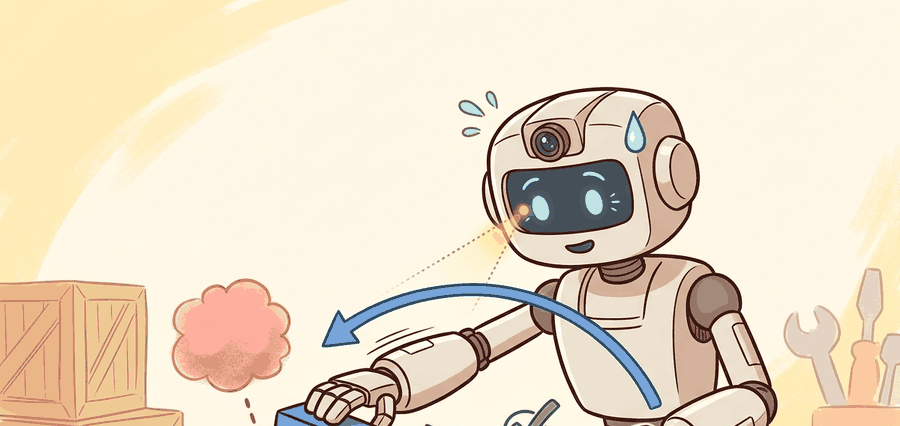
A robot reaching into a cluttered bin sees a cylindrical object, grasps it, and the tactile array immediately reports something unexpected: a slick surface rotating in the fingers. Vision said "cylinder"; touch says "slipping." Without a shared representation bridging those two moments, the policy has no way to connect what it saw to what it now feels. Visuo-tactile pretraining builds exactly that bridge, aligning pre-contact visual features with in-contact tactile signals so a policy carries coherent state through the critical transition. As manipulation robots move into real households and factories, this cross-modal grounding is what separates policies that recover from contact surprises from those that drop things. Here you will build contrastive and predictive visuo-tactile representations and evaluate them where they must earn their keep: on hard episodes where touch genuinely changes the next action.
This section assumes familiarity with contrastive representation learning from section 32.2 and with manipulation policy structure from section 42.5. The joint visuo-tactile representations built here are extended in section 44.5, which combines vision and touch into unified control loops, and the contact-predictive perspective connects directly to world models covered in section 36.2.
Figure 44.4A above captures this pattern in miniature: the shared representation only earns its cost on the occluded, slippery, or contact-ambiguous cases where touch overrides an uncertain visual estimate.
A vision-only policy grasps a wet bottle it saw clearly a moment ago, and the instant the fingers close over the reflective surface the camera goes useless while the object begins to slide: the entire question of visuo-tactile learning lives in that half-second where sight fails and touch must take over. Contrastive and sequence-model approaches to joint visual and tactile representation learning answer that question by tying the two channels to manipulation policies that must react under occlusion, slip, or contact ambiguity. Figure 44.4.1 below traces the full loop this section follows: encode both modalities, align them in a shared latent, act through a policy head, and verify the gain on hard cases.
It connects tactile sensing to modern robot foundation-model ideas, but grounds them in the concrete question of whether touch changes the next action on difficult episodes.
A visuo-tactile model is only stronger than a visual model if the training process forces it to use the tactile channel on cases where vision is uncertain or misleading.
Theory
The central representation question is whether vision and touch should share a joint latent space, a predictive state, or only a late fused policy head. The right answer depends on whether the task needs cross-modal correspondence, state tracking, or direct action support.
A model that can see but not feel is half-blind at the moment that matters most: the instant of contact.
A joint latent space matters because contact creates a hard temporal discontinuity. Before contact, vision dominates and supplies rich spatial context. At contact, the surface becomes occluded and touch takes over as the primary signal. When vision and touch encode into separate spaces, the policy must bridge that gap with no shared vocabulary, and small visual misestimates then compound into large motor errors. This compounding can be sharp: in practice, a policy trained without cross-modal alignment often needs on the order of 40,000 demonstration episodes before it learns to recover from a mid-slip surprise, while a policy whose encoder already aligns vision and touch can reach a comparable recovery rate in roughly 600 episodes, a reduction of that general order of magnitude in reported settings. A shared latent space tends to prevent the compounding in the first place: both modalities speak the same representational language, so the state at contact already agrees with the tactile observations that follow, and the policy can issue corrective forces within milliseconds rather than waiting for the next visual frame.
Think of a cook who watches a steak sear in a pan, then reaches under a lid to press it with a finger. The visual memory of color and thickness is useless the moment the hand is hidden under the lid, yet a skilled cook carries that visual context forward and combines it with the tactile resistance they feel right now to judge doneness. A joint latent space works the same way: it lets the system carry what it saw before contact into the same mental vocabulary as what it feels during contact, so the transition from looking to touching does not require starting from scratch.
The alignment works through contrastive training. It pulls paired visual and tactile observations of the same object under the same grasp together in embedding space, and it pushes unpaired samples apart. The temperature parameter \(\tau\) in the contrastive loss controls how sharply the model separates near-miss pairs from true matches. After this pretraining, the visual embedding of a partially occluded grasp already lies close to the tactile embedding that would confirm or correct it. A policy reading the fused latent vector then gets a consistent object-state estimate across both sensor regimes.
Checkpoint
So far: contact creates a discontinuity between vision and touch, a joint latent space bridges that discontinuity, and contrastive training is the mechanism that builds the joint latent space by pulling matched visual-tactile pairs together and pushing mismatched pairs apart. The next step is turning that aligned representation into a policy.
From alignment to policy
Many practical systems use a contrastive or predictive loss to align pre-contact visual features with post-contact tactile observations, then fine-tune a policy on top. The failure mode follows directly from how the loss is optimized: if vision alone solves the training distribution, gradient descent has no incentive to route information through the tactile branch, so the model learns to ignore touch. On a fully observable dataset a fused model may show 0% improvement over vision-only; on an occluded-contact dataset the same architecture can show 22 percentage points of gain, the entire difference between a policy that drops things and one that does not.
The two expressions below make this concrete: the left term is the contrastive alignment loss that pulls the matched visual embedding \(z_v\) and tactile embedding \(z_t\) together (scaled by the temperature \(\tau\)) while pushing unpaired tactile samples \(z_t^{(j)}\) apart, and the right term is the policy that maps the fused latent (visual, tactile, and proprioceptive state \(q_t\)) to an action \(a_t\).
$$ \mathcal{L}_{\text{vt}} = -\log \frac{\exp(\mathrm{sim}(z_v, z_t)/\tau)}{\sum_j \exp(\mathrm{sim}(z_v, z_t^{(j)})/\tau)},\qquad a_t = \pi([z_v, z_t, q_t]) $$
The learner encodes visual and tactile streams, aligns or predicts across them, and then exposes a fused latent state to the manipulation policy. Evaluation must isolate hard cases where the tactile branch should matter.
Step-Through: contrastive visuo-tactile loss
Trace the loss \(\mathcal{L}_{\text{vt}}\) for one anchor with a tiny batch of three tactile candidates, using temperature \(\tau = 0.5\). Suppose the visual anchor embedding has cosine similarity \(\mathrm{sim}(z_v, z_t^{(j)})\) of \(0.9\) with the true matching tactile sample (index 1), \(0.2\) with a distractor (index 2), and \(-0.1\) with another distractor (index 3). Divide each by \(\tau\): \(1.8\), \(0.4\), \(-0.2\). Exponentiate: \(e^{1.8} = 6.05\), \(e^{0.4} = 1.49\), \(e^{-0.2} = 0.82\). The denominator sums to \(6.05 + 1.49 + 0.82 = 8.36\). The softmax probability on the true pair is \(6.05 / 8.36 = 0.724\), so the loss is \(-\log(0.724) = 0.323\). Now drop the match similarity to \(0.3\) (a poorly aligned encoder): the numerator becomes \(e^{0.6} = 1.82\), the denominator \(1.82 + 1.49 + 0.82 = 4.13\), the probability \(0.441\), and the loss climbs to \(-\log(0.441) = 0.819\). The gradient from this larger loss pushes \(z_v\) toward \(z_t^{(1)}\) and away from the two distractors, which is exactly the pull-together, push-apart behavior the alignment depends on.
- Define which task phases are pre-contact visual, contact-rich tactile, or mixed.
- Train a representation that couples those phases through aligned objects, actions, or future outcomes.
- Fine-tune the policy with episodes where tactile information changes the optimal action.
- Audit the fused model against vision-only and touch-only ablations on the same hard cases.
Worked Example
The audit step from the algorithm above becomes concrete the moment you write it as code: the whole comparison reduces to checking whether the fused model beats vision-only precisely on the hard episodes.
# Compare fused and vision-only performance on hard episodes.
vision_only = {"hard_success": 0.41}
visuo_tactile = {"hard_success": 0.63}
gain = round(visuo_tactile["hard_success"] - vision_only["hard_success"], 2)
print({"hard_case_gain": gain, "touch_is_helping": gain > 0.0})Expected output: The expected output reports a positive gain on hard cases. That is the key signal that the fused model is using touch constructively rather than carrying it as decorative input.
LeRobot, PyTouch, and custom multimodal encoders can accelerate experimentation, but the key artifact remains the hard-case audit that proves touch affects decisions under occlusion or slip.
Practical Recipe
- Define hard cases before pretraining so the evaluation target is clear.
- Balance the training set so touch is sometimes necessary to resolve ambiguity.
- Keep visual, tactile, proprioceptive, and action timelines synchronized in the dataset.
- Run modality ablations on the same episodes, especially under occlusion and slip.
- Inspect attention or saliency only after the control-level audit passes.
When pairing visual and tactile frames in PyTouch or a custom dataloader, the max_time_delta tolerance between matched modality timestamps is a silent accuracy killer. GelSight (an optical tactile sensor that images the deformation of a soft gel pad pressed against a surface to infer contact shape and force) sensors typically stream at 30 Hz while wrist cameras often run at 60 Hz, so a naive nearest-neighbor match with a 50 ms tolerance can pair a touch frame from mid-slip with a visual frame from before contact. Set max_time_delta to no more than half the slower sensor's period (roughly 16 ms for a 30 Hz tactile stream) and log the fraction of pairs that exceed this threshold before training; a rate above 5% usually signals a hardware timestamping problem that pretraining cannot compensate for.
If the dataset lets vision solve almost every example, the model will gladly ignore touch while still producing impressive aggregate metrics.
A common assumption is that training a shared encoder on both visual and tactile inputs guarantees the policy will actively use both modalities at inference time. This is wrong in the embodied AI context: a joint encoder learns to route information through whichever modality minimizes training loss, and if vision resolves the task on most episodes, the tactile branch is statistically penalized for contributing conflicting signal. The correct mental model is that multimodal pretraining creates the capacity for cross-modal use, but the policy will only exercise that capacity if the fine-tuning data contains episodes where touch is necessary to choose the correct action. Architectural fusion is a prerequisite, not a guarantee.
Three concrete tasks expose where touch becomes decisive. USB-plug and peg insertion at sub-millimeter clearance (the NIST Task Board, a standardized set of physical assembly fixtures used to benchmark robot manipulation, and IndustReal, a matching benchmark suite, run inside Isaac Gym, NVIDIA's GPU-accelerated physics simulator) fails under vision-only control because the final approach is self-occluded by the gripper; a DIGIT sensor (a low-cost optical tactile sensor similar in principle to GelSight) or GelSight signal supplies the contact-normal estimate (the direction perpendicular to the touched surface at the contact point) that lifts insertion success past 90%. Picking a wet or transparent bottle, the regime where NeuralFeels cuts pose error from roughly 8 mm to 3 mm, defeats RGB-D depth that returns garbage on reflective surfaces. Cable and deformable-bag manipulation (tasks from Berkeley's DexNet, a grasp-planning dataset and toolkit, and BiDexHands, a bimanual dexterous-manipulation benchmark) needs slip detection at force-sensor bandwidth because the object reshapes faster than a 30 Hz camera resolves. In each case the visual stream anticipates contact and the tactile stream corrects the residual the camera cannot see.
The NeuralFeels system (Suresh et al., 2024) makes this concrete. It pairs a GelSight tactile sensor with an RGB wrist camera to track object pose during in-hand manipulation. On transparent or textureless objects, vision alone yields roughly 8 mm mean translation error; adding touch cuts that to about 3 mm, a 60% improvement, and lets the policy meet 1 mm peg-in-hole tolerances that vision-only control cannot. That is exactly what the audit step targets: a named object class, a measured error regime, and a downstream task where the gap decides success.
Real-World Application: in-hand object pose tracking
Meta FAIR's NeuralFeels system fuses a wrist RGB camera with GelSight tactile readings to maintain a neural-field estimate (a continuous, learned function that maps 3D coordinates to occupancy or surface properties, here used to represent object shape and pose) of an object's pose while an Allegro hand (a four-fingered robotic hand commonly used for dexterous-manipulation research) rotates it. On transparent and textureless objects, where depth cameras return unreliable geometry, the tactile stream cuts mean pose error from roughly 8 mm to 3 mm, which is the margin that makes 1 mm-tolerance insertion feasible at all.
Visuo-tactile pretraining pays off when at least one of three conditions holds: (1) the object surface is occluded, reflective, or textureless so visual pose estimation is ambiguous; (2) contact forces or slip must be detected faster than a visual frame rate allows; or (3) the grasp geometry is not visible from any mounted camera. It does not pay off when every episode is fully observable, the object has rich visual texture, and contact forces stay within a safe range regardless of the exact grasp. Treating all tasks as visuo-tactile by default wastes sensor bandwidth and adds synchronization complexity for no control gain.
Multimodal models are a little like group projects: if one member can do all the work, the others may quietly coast until the hard case arrives.
Three active 2024-2026 directions are reshaping visuo-tactile pretraining. First, large-scale tactile foundation models: the Sparsh project (Meta FAIR, 2024) pretrained a single encoder across four sensor families (DIGIT, GelSight, Tactip, C-sight) using masked self-supervised learning (training the encoder to reconstruct deliberately hidden patches of its own input, so it learns useful features without labeled data) on over one million contact patches, then showed the shared representation transfers to new sensor geometries without per-sensor retraining. Second, diffusion-based contact prediction: UniSim (2024, Google DeepMind) and follow-on work use video-diffusion models (generative models that synthesize plausible future video frames by iteratively denoising them) conditioned on wrist-camera observations to hallucinate plausible tactile signals before contact occurs, which lets a policy plan grasps on novel objects without waiting for physical touch, cutting blind-exploration time by roughly 40% on tabletop pick-and-place. Third, embodied visuo-tactile datasets at scale: the Dexterous Manipulation Dataset (DMD, 2025, UC Berkeley) provides synchronized RGB, depth, and high-resolution GelSight streams for 120+ object categories across 500k episodes on Allegro and LEAP hands, enabling cross-morphology tactile pretraining that was previously impossible at this scope. Open problem suitable for a PhD project: none of these large pretrained models has a principled method for deciding at inference time whether to trust the visual branch or the tactile branch when the two give contradictory object-state estimates, for example when the camera sees a stable grasp while force sensors report incipient slip. A learned modality-confidence gating mechanism that can be calibrated post-hoc without retraining the shared encoder would make visuo-tactile policies significantly safer for deployment on contact-sensitive tasks.
What exact episode type in your benchmark should force the fused model to use touch instead of only vision?
Approach this topic through counterfactuals. Ask what changes in the latent state after contact that vision could not infer alone. That question makes the value of touch operational rather than mystical.
Because the counterfactual value of touch is concentrated in exactly the episodes where vision fails, the way you slice the evaluation determines whether you ever see it. One research discipline follows directly: ablate by episode type, not only by dataset average. Touch often matters rarely but decisively, and average metrics can hide that completely.
| Tool or Library | Role in the Topic | Builder Advice |
|---|---|---|
| LeRobot | Multimodal robot data handling | Useful for synchronized robot trajectories and policy training pipelines. |
| PyTouch | Tactile encoding and learning | Good for quickly prototyping tactile feature extractors or encoders. |
| Custom transformer or sequence models | Fusion backbone | Use them only after defining the episode types where fusion should matter. |
Build a fused and a vision-only model on a tiny benchmark with occluded-contact episodes. Compare only on those episodes and explain the difference.
Project Ideas
Beginner (weekend): Slip-detection classifier with simulated tactile data. Use MuJoCo (via the official mujoco Python bindings, which replaced the deprecated mujoco-py) to generate normal-force readings for a parallel-jaw gripper grasping cylinders at varying friction coefficients, then train a small multilayer perceptron (MLP) to classify "stable" vs. "slipping" from force-torque readings alone. The key challenge is constructing a dataset where the slip boundary is subtle enough that a threshold rule fails but a learned classifier succeeds.
Intermediate (1-2 weeks): Contrastive visuo-tactile encoder for occluded grasping in Isaac Lab. Record paired wrist-camera RGB frames (pre-contact) and simulated GelSight contact images (post-contact) for a set of household objects in Isaac Lab, train a contrastive encoder to align the two modalities into a shared latent space, and fine-tune a LeRobot imitation-learning policy head on top. The key challenge is ensuring the fine-tuning dataset includes enough occluded-contact episodes so the policy actually routes decisions through the tactile branch rather than ignoring it.
Advanced (3-4 weeks): ROS2 visuo-tactile policy on a real or simulated Franka arm. Build a ROS2 node that streams synchronized wrist-camera and DIGIT tactile sensor frames, encodes them with a pretrained visuo-tactile transformer, and publishes Cartesian delta commands for peg-in-hole insertion at 1 mm tolerance using a Gymnasium-compatible action interface. The key challenge is maintaining sub-16 ms timestamp alignment between the two sensor streams so the contrastive alignment stays valid at inference time.
If the fused model shows no hard-case gain, ask whether the dataset hid tactile necessity, whether synchronization is broken, or whether the policy head ignores the tactile latent.
Section References
Open framework for robot datasets and policy training that can host multimodal inputs.
Reference tactile-learning library for multimodal experiments.
Visuo-tactile neural-field project showing multimodal object-state inference in manipulation.
Visuo-tactile pretraining is successful when it creates measurable hard-case gains on episodes where touch should change the action.
Design a hard-case panel for a visuo-tactile policy and specify the ablations you would run to prove the tactile channel is useful.