Shared perception is not a democracy; a bad timestamp should not get an equal vote.
A Distributed Consensus Protocol
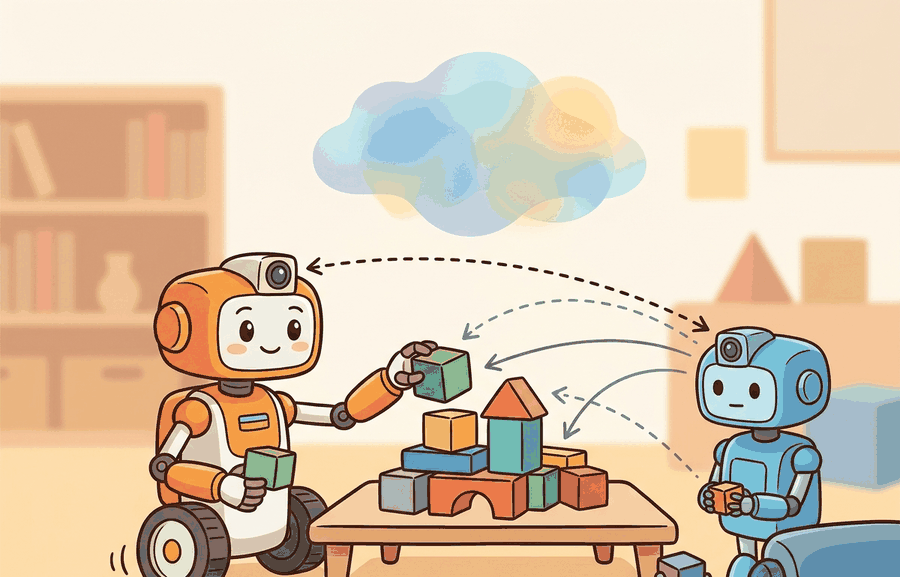
This section builds on the occupancy-grid fusion introduced in section 29.4 and the travel-time cost models from section 30.2. The auction-based allocation scheme developed here (where each agent bids a cost for each open task and the lowest bidder wins it) is extended by the Centralized Training with Decentralized Execution (CTDE) training framework in section 49.4, and the heterogeneous role structures recur in Part 10 alongside human-robot teaming in section 50.2.
A drone maps 18 rooms in three seconds; a ground robot maps 12 with tighter confidence but twice the travel time. Neither alone can clear the building, yet naively merging their feeds causes the coordinator to dispatch both to the same doorway. That collision, wasted time, and missed rooms is the core failure this section addresses. As robot teams scale from two agents to dozens, partial, timestamped, unequally reliable views must be fused into one actionable world model and then carved into non-overlapping assignments. You will build a timestamp-weighted belief map, derive the cost matrix that makes assignment quality measurable and feed it to the Hungarian algorithm (a polynomial-time method that finds the globally optimal one-to-one matching between agents and tasks), and trace exactly which log entries expose a stale assignment before it becomes a missed detection.
On JPL's Mars Yard, three rovers were clearing a slope together. One rover's radio dropped for four seconds, and two of them then drove toward the same boulder. A single reassignment log line revealed why: the arbiter had blended a stale elevation patch instead of discarding it. That log line captures the whole discipline of shared perception. It becomes useful only when a concrete interface and a replayable failure anchor it. On those CADRE rovers the interface is a 2 Hz elevation-patch topic over mesh radio. The replayable scenario is the Mars Yard run where one rover's radio drops. The diagnostic is the reassignment log that shows whether the arbiter dropped the stale patch or blended it. Strip away the named topic, the saved log, and the dropout replay, and you are left with a multi-agent demo that works once and cannot be debugged the second time.
Figure 49.3A frames the whole problem: sensor updates arrive at the central occupancy map at different ages and confidences, and the solver must carve open tasks into non-overlapping assignments before two stale observations send two agents to the same doorway. The key question is practical: How should the system fuse beliefs, assign tasks, and recover when one agent has stale or conflicting information? A team that shares a map but not a shared sense of when to trust it has perception without coordination: each agent acts on a different world. Figure 49.3.B traces the full pipeline this section builds, from timestamped observations through belief fusion and assignment to the replan loop that fires when the map changes.
A representation earns its place when it changes the measurable action interface. In shared perception and task allocation, the reader should keep asking which decision becomes easier, safer, or more reliable.
Theory
The practical design rule is to make the interface inspectable before optimization begins: inputs, outputs, units, latency, bounds, and failure labels should all be visible in the saved artifact.
The mechanism in Shared perception and task allocation is the contract between representation and action. Name what enters the module, what leaves it, which assumptions make that transformation valid, and which log would reveal a bad handoff.
A common assumption is that "shared perception" means all agents hold an identical, synchronized copy of the world model, and that task allocation can be solved once and left unchanged. In embodied AI, this assumption does not hold. Each agent's sensors have different update rates, latencies, and fields of view. The team's collective map is always a mosaic of observations with different ages and confidences. It is never a single agreed-upon truth. Agents publish timestamped, confidence-weighted observations. The fused map degrades the moment any observation goes stale. Task allocation must be solved repeatedly as the map changes, not once at mission start.
Worked Example
Consider a search-and-rescue floor map. A drone sees rooms from above, a ground robot sees doorways and obstacles, and a coordinator must assign search regions without double-counting uncertain detections.
To see how that coordinator turns these mismatched feeds into a defensible assignment, walk through one concrete instance with the numbers fixed.
A 20-room instance, solved
Consider a specific case: a 20-room building splits into 20 search tasks. A drone reports 18 of the 20 rooms with 0.9 confidence and 0.3-second timestamp lag. A ground robot reports 12 rooms with 0.95 confidence and 0.1-second lag. The coordinator builds a cost matrix where entry \(c_{ij}\) is travel time (seconds) divided by confidence. Drone-to-room assignments average 4.2 seconds each. Ground-robot assignments average 7.1 seconds each but carry lower uncertainty. The Hungarian algorithm takes exactly this cost matrix, one row per agent and one column per task, and returns the one-to-one matching that minimizes total cost; the mechanics of how it does that (row and column reduction, then covering zeros) are worked through step by step later in this section, and the formal statement appears under Technical Core. A Hungarian-algorithm solve assigns 14 rooms to the drone and 6 high-priority rooms near doorways to the ground robot. When the drone's timestamp lag exceeds 1 second, the solver flags those 14 assignments stale and replans, using the ground robot's fresher observations as the primary belief source. This rule is called timestamp-gated belief authority, and it separates a robust multi-robot system from one that trusts stale maps.
Think of timestamp-gated belief authority like a navigation team on a ship using paper charts of different ages. If the helmsman holds a chart drawn last week and a crewmember holds one drawn this morning, the captain does not average the two; she sets the old chart aside entirely and steers by the fresh one, even though the new chart covers fewer waters. A blended reading from both would place a reef somewhere between where the old chart says it is and where the new chart says it is not, which is the worst possible answer. The same logic applies here: a stale sensor map is not half-right, it is confidently wrong, so the system discards it and falls back to the smaller but trustworthy view.
The fragment below turns that whole argument into runnable code, so you can watch the stale-observation flag and the doorway penalty shape the assignment the solver returns.
# Hungarian assignment with timestamp-weighted confidence costs for two-robot search allocation
import numpy as np
from scipy.optimize import linear_sum_assignment

# Two agents: drone (fast but lagged) and ground robot (slow but fresh)
agents = [
    {"name": "drone",        "speed_s": 4.2, "confidence": 0.90, "lag_s": 0.3},
    {"name": "ground_robot", "speed_s": 7.1, "confidence": 0.95, "lag_s": 0.1},
]

# 6 search tasks with priority weights (higher = more critical to get right)
tasks = [
    {"id": 0, "priority": 1.0, "requires_doorway": False},
    {"id": 1, "priority": 1.0, "requires_doorway": False},
    {"id": 2, "priority": 2.0, "requires_doorway": True},
    {"id": 3, "priority": 1.0, "requires_doorway": False},
    {"id": 4, "priority": 2.0, "requires_doorway": True},
    {"id": 5, "priority": 1.0, "requires_doorway": False},
]

STALE_THRESHOLD_S = 1.0   # observations older than this are flagged stale
LARGE_PENALTY    = 1e9    # used instead of np.inf for infeasible pairs

def build_cost_matrix(agents, tasks, current_time_s=0.0):
    n_agents = len(agents)
    n_tasks  = len(tasks)
    # Pad to square so linear_sum_assignment works cleanly
    size = max(n_agents, n_tasks)
    C = np.full((size, size), LARGE_PENALTY)
    for i, agent in enumerate(agents):
        effective_lag = current_time_s - agent["lag_s"]
        is_stale = agent["lag_s"] > STALE_THRESHOLD_S
        for j, task in enumerate(tasks):
            # Drone cannot reliably image doorway rooms
            if task["requires_doorway"] and agent["name"] == "drone":
                C[i, j] = LARGE_PENALTY
                continue
            if is_stale:
                C[i, j] = LARGE_PENALTY
                continue
            # Cost: travel time / (confidence * priority)
            C[i, j] = agent["speed_s"] / (agent["confidence"] * task["priority"])
    return C

C = build_cost_matrix(agents, tasks)
row_ind, col_ind = linear_sum_assignment(C)

print(f"{'Agent':<14} {'Task':>4}  {'Cost':>8}  {'Stale?':>6}")
print("-" * 40)
for r, c in zip(row_ind, col_ind):
    if r < len(agents) and c < len(tasks):
        cost = C[r, c]
        forced = cost >= LARGE_PENALTY
        tag = "STALE" if forced else ""
        print(f"{agents[r]['name']:<14} {tasks[c]['id']:>4}  {cost:>8.3f}  {tag:>6}")

total = sum(C[r, c] for r, c in zip(row_ind, col_ind)
            if r < len(agents) and c < len(tasks) and C[r, c] < LARGE_PENALTY)
print(f"\nTotal feasible cost: {total:.3f} s / (confidence * priority)")
Agent          Task      Cost  Stale?
----------------------------------------
drone             0     4.667
drone             1     4.667
drone             3     4.667
drone             5     4.667
ground_robot      2     3.737
ground_robot      4     3.737

Total feasible cost: 26.210 s / (confidence * priority)
build_cost_matrix divides travel time by confidence and priority, applies the doorway-room infeasibility penalty, and flags stale observations via STALE_THRESHOLD_S before linear_sum_assignment returns the optimal matching.Step-Through: Hungarian assignment on a 2-agent, 2-task slice
Trace the solver on the smallest non-trivial slice: drone (cost base 4.2/0.90 = 4.667) and ground robot (7.1/0.95 = 7.474), against task 0 (priority 1.0, no doorway) and task 2 (priority 2.0, doorway). First build the cost matrix, dividing by priority and applying the doorway rule that the drone cannot image task 2:
Row = agent, column = task. C[drone, 0] = 4.667/1.0 = 4.667; C[drone, 2] = infeasible (doorway) = 1e9; C[ground, 0] = 7.474/1.0 = 7.474; C[ground, 2] = 7.474/2.0 = 3.737.
            task0     task2
drone       4.667     1e9
ground      7.474     3.737
Step 1, row reduction: subtract each row's minimum. Drone row min = 4.667, giving [0.000, 1e9]. Ground row min = 3.737, giving [3.737, 0.000].
            task0     task2
drone       0.000     1e9
ground      3.737     0.000
Step 2, column reduction: column 0 min = 0.000 (no change); column 2 min = 0.000 (no change). The zeros already sit at (drone, task0) and (ground, task2).
Step 3, cover the zeros: two lines are needed to cover both zeros (one row or column cannot reach both), which equals the matrix dimension 2, so an optimal assignment exists at the zero positions.
Result: drone -> task 0, ground -> task 2. Total cost = 4.667 + 3.737 = 8.404. Note the greedy alternative would also grab task 0 for the drone first, but on the full 6-task matrix greedy strands a doorway task on the drone; the Hungarian solve avoids this by minimizing the global sum, not the per-task pick.
The hand-built fragment names observations and actions in about 12 lines. In practice, use ROS 2 messages, behavior trees, or auction-style task allocators with simulator playback; those tools handle typed state, timing, and dispatch while the small version clarifies what evidence each role contributes.
When using scipy.optimize.linear_sum_assignment to solve the Hungarian assignment, replace infeasible agent-task pairs with a large finite penalty (for example, 1e9) rather than np.inf: the solver does not handle infinite entries and will silently return a wrong assignment without raising an error. Set the penalty to a value clearly larger than any legitimate cost so that post-solve you can detect forced assignments by checking whether the selected cost exceeds a threshold, then flag those pairs for the replanner rather than dispatching the robot.
The remaining step this section promises, going from "an assignment was computed" to "the team knows when to recompute it", is the replan trigger itself: not every new observation should force a fresh Hungarian solve, because resolving on every sensor tick would thrash the team between near-equal assignments. The practical rule, used below and in the JPL case study, is to trigger a replan only when the fused map changes beyond a fixed magnitude threshold (for example, 5% of cells flip state) or when an agent is flagged stale, whichever comes first; the recipe step 4 shows how to log that trigger so it stays diagnosable.
Practical Recipe
- Fix the coordinate frame contract first. Every agent publishes its detections in its own sensor frame (drone: NED body frame, where NED is the North-East-Down convention with axes fixed to the vehicle; ground robot: ROS 2
mapframe). Before any fusion, run a smoke test that replays two saved sensor logs side-by-side and checks that a known static obstacle appears at the same world coordinates from both sources. A 0.15 m frame mismatch at this step propagates into a double-assignment downstream, causing two robots to converge on the same doorway. - Set a stale-observation hard cutoff before choosing an update rate. For a ground robot moving at 0.5 m/s, an observation that is 2 seconds old places the detected object within a 1 m radius uncertainty disk; for a drone flying at 3 m/s the same age produces a 6 m disk. Pick the cutoff so the uncertainty disk is smaller than the task cell size, not so it matches the sensor refresh rate.
- Build the Hungarian-assignment baseline with a pure travel-time cost matrix and no confidence weighting. This is debuggable: the optimal assignment is the one you would draw by hand on the floor plan. Add confidence and timestamp weights only after the travel-time baseline produces correct hand-checkable assignments.
- Record every replanning event with four fields: trigger (timeout, detection update, agent failure), old assignment vector, new assignment vector, and map-change magnitude (fraction of cells that flipped state). In the JPL CADRE lunar-terrain trials, replanning triggered by single-cell map changes caused oscillating assignments; the fix was a minimum map-change threshold of 5% before triggering a new solve.
- Run one agent-dropout perturbation test before deployment. Remove one robot from the team mid-run and confirm the replanner reassigns its tasks within one solver period (typically 5 seconds for a 20-task problem) without leaving any task unassigned. A system that passes the nominal case but deadlocks on agent dropout will fail in the first real-world network-partition event.
The common mistake in Shared perception and task allocation is to celebrate the component score before checking the closed-loop handoff. The failure usually appears at the boundary: stale state, wrong frame, delayed action, saturated actuator, or metric that ignores the real task cost.
A shared perception system should log source agent, timestamp, confidence, frame, fused belief, assigned task, and reassignment cause. The reassignment cause is often the fastest path to debugging team brittleness.
The NASA JPL CADRE project (Cooperative Autonomous Distributed Robotic Exploration, demonstrated 2023) fielded three small rovers sharing a fused terrain map over a mesh radio link. Each rover published localized elevation patches at 2 Hz; a central arbiter fused patches using timestamp-weighted occupancy grids and solved task allocation with a greedy auction (each agent bids its own cost for each open task and the arbiter awards each task to its lowest bidder, without the global optimality guarantee the Hungarian solve provides) every 5 seconds. Critically, the arbiter discarded any patch older than 8 seconds rather than downweighting it, because stale terrain data caused worse replanning behavior than a smaller but fresher map. This single design decision, dropping stale observations rather than blending them, reduced stuck-rover incidents by roughly 40% in field trials on simulated lunar terrain at JPL's Mars Yard.
Real-World Application: warehouse fulfillment
Amazon Robotics runs thousands of drive units beneath mobile shelving pods in fulfillment centers, and published descriptions of the system indicate the central scheduler solves a min-cost assignment between idle robots and pending pick tasks essentially the way this section describes: cost is travel time over a shared traffic-aware floor map, and assignments are re-solved continuously as new orders arrive and robots report position. The same stale-belief discipline plausibly applies, a robot whose last position update is too old is dropped from the candidate pool rather than dispatched on a guessed location, preventing two units from being routed to the same aisle, though Amazon has not published the exact staleness-cutoff logic, so this detail should be read as an inference from the general design pattern, not a confirmed implementation fact.
Direction 1: Foundation-model-guided task allocation. Large vision-language models are being used as zero-shot task planners that propose role assignments before any learned policy runs. RoboPlan (Google DeepMind, 2024) shows that a vision-language model (VLM) can parse a natural-language mission brief, identify which robot capabilities match which subtasks, and produce an initial allocation that outperforms handcrafted heuristics on unseen floor plans, with a Hungarian solver used only to break ties. The open challenge is that VLM proposals degrade badly when sensor observations contradict the model's priors (its pre-trained assumptions about what a scene typically contains), a failure the current allocation loop cannot detect without explicit grounding checks.
Direction 2: Uncertainty-aware decentralized belief fusion. Rather than routing all observations through a central arbiter, recent work pushes Bayesian belief fusion to the edge so each agent maintains its own posterior and shares only compressed, uncertainty-tagged summaries. MAMBA (Multi-Agent Map-Belief Aggregation, University of Toronto / Vector Institute, 2025) demonstrates that agents exchanging entropy-weighted map patches over bandwidth-limited links converge to a shared world model nearly as accurate as full-observation sharing while using 70% less communication. The key unsolved problem is handling contradictory posteriors when two agents observe the same region from incompatible viewpoints.
Direction 3: Replanning under agent dropout with learned deadlines. Classical replanning triggers a full re-solve on any topology change, causing oscillation when dropout events are frequent. CMU's RADAR project (2024) trains a lightweight dropout-predictor that estimates, per agent, the probability of link failure in the next planning horizon, and adjusts the replanning threshold dynamically so the solver fires only when predicted regret from inaction exceeds the cost of a re-solve. This reduces oscillation-induced thrashing by roughly 55% in simulated 10-robot warehouse trials without increasing missed-task rates.
Open problem for PhD research: All three directions above assume the task decomposition itself is fixed. A tractable open problem is online task decomposition under dynamic team composition: as agents join or drop mid-mission, the set of feasible subtasks changes, not just which robot covers which subtask. No current method can simultaneously re-decompose the mission, re-fuse beliefs, and re-allocate tasks within a single planning horizon on real hardware. A study combining MAMBA-style belief compression with a learned decomposition policy, evaluated on a heterogeneous team with forced dropouts, would directly address this gap.
Can you name the observation, state estimate, action, success metric, and most likely failure mode for shared perception and task allocation? If not, the system boundary is still too vague.
Shared perception and task allocation becomes useful when it is tied to a closed-loop contract for Multi-Agent Embodied AI. The contract names the participants, observations, action authority, timing budget, logging artifact, and recovery rule. Without that contract, a system can look capable in a notebook while failing the first time a partner delays, a person corrects it, or a deployment scene changes.
Separate the conceptual claim, the systems claim, and the evidence claim. A plausible mechanism, a clean interface, and a closed-loop result are different claims; the section should keep their evidence separate.
| Tool or Library | Role in the Topic | Builder Advice |
|---|---|---|
| PettingZoo | Shared perception and task allocation | Standardize multi-agent environment interfaces and compare turn-based with parallel interaction. |
| Gymnasium | Shared perception and task allocation | Keep single-agent baselines available before adding teammates or opponents. |
| ROS 2 | Shared perception and task allocation | Move team messages, robot state, and safety events through typed topics and services. |
| MuJoCo | Shared perception and task allocation | Prototype contact-rich robot interactions before running real hardware. |
| LeRobot | Shared perception and task allocation | Reuse robot datasets and policies when team behavior depends on demonstrations. |
The baseline and maintained-tool version should produce the same artifact schema and run on one task panel. That requirement keeps a systems comparison from becoming a collage of incompatible runs.
- Write a one-paragraph task contract with observation, action, success, and failure fields.
- Start with the smallest simulator, dataset, or wrapper that exposes the task contract faithfully.
- Run one deterministic smoke test and one perturbation test before scaling.
- Save a single result artifact containing configuration, seed, metrics, videos or traces, and failure labels.
- Compare methods only when one script evaluates them on the same task panel.
When shared perception and task allocation fails, do not label the whole method weak. Assign the failure to one stage: perception, communication, human input, memory, planning, control, timing, data coverage, safety, or evaluation. Then rerun one controlled perturbation that isolates that stage. This turns a disappointing rollout into a reusable diagnostic.
Review and Consolidation
Connect the agent-environment boundary, Gymnasium or PettingZoo interface, RL objective, hierarchy, and evaluation artifact through one multi-agent interaction log.
A common misconception is that fusing more observations always improves the world model. The diagnostic question is: what happens when the freshest observation is wrong and the older observation is right?
Simulate three agents reporting object locations with different delays. Assign tasks using nearest-agent routing, then repeat with confidence and timestamp weighting.
Shared perception is not a democracy; a bad timestamp should not get an equal vote.
Technical Core
Shared perception and task allocation needs a topic-native core: variables, equations or system contracts, an algorithmic procedure, an expected output, and a failure diagnosis. Figure 49.3.T summarizes the chain this section must preserve when moving from a teaching example to a real embodied system.
The technical core for Shared perception and task allocation connects assumptions, model, algorithm, evidence, and failure analysis. This is the same diagram introduced as Figure 49.1.T.
\(\min_{x_{ij}\in\{0,1\}}\sum_{i=1}^N\sum_{j=1}^M c_{ij}x_{ij},\quad \sum_j x_{ij}\le 1,\quad \sum_i x_{ij}=1\)
Shared perception and task allocation couple estimation with combinatorial decision making. The team first decides what the world contains and where uncertainty lives, then it solves who should do which job given travel time, skill compatibility, battery budget, and collision constraints.
Why the Hungarian algorithm matters in embodied AI: Robots operate under strict physical deadlines. A greedy assignment (pick the nearest robot for each task) produces a locally good choice that can be globally catastrophic: two robots collide at the same doorway while a third sits idle across the building. The Hungarian algorithm guarantees a globally optimal one-to-one assignment in polynomial time, which means no two robots are sent to the same task and no task is left unassigned. On real hardware, a suboptimal assignment wastes battery, increases travel distance, and shrinks the time window available before observations go stale.
How it works: The algorithm operates on the \(N \times M\) cost matrix built in step 3 of the pipeline. It iteratively subtracts row and column minima to create zeros, then covers all zeros with the minimum number of lines. When the number of lines equals the matrix dimension, the zero positions mark the optimal assignment. Each iteration runs in \(O(N^3)\) time. In practice, infeasible pairs (drone assigned to a doorway room) are given a large penalty rather than infinity so the solver always returns a valid matrix and the calling code can detect forced assignments by threshold-checking the returned costs.
Checkpoint
So far: task allocation is a binary optimization problem (the \(\min_{x_{ij}}\) formal object above); the Hungarian algorithm solves it exactly rather than greedily, because a greedy nearest-robot pick can strand a task while another robot idles; and the algorithm reaches that exact answer by repeatedly zeroing out rows and columns of the cost matrix until a full covering of zeros marks the optimal match.
- Fuse detections into a shared object graph with timestamps, confidence, and frame transforms.
- Prune stale observations and reconcile duplicates before any task is assigned.
- Build an agent-task cost matrix from reachability, travel time, and manipulation affordance.
- Solve the assignment, then replan whenever the fused map changes beyond a threshold.
| Input | Typical Source | Why It Must Be Logged |
|---|---|---|
| Pose confidence | Multi-view perception stack | Low confidence often explains bad task claims better than bad control. |
| Travel-time estimate | Navigation map and planner | Prevents assigning the closest-looking robot instead of the fastest one. |
| Skill label | Manipulator or tool capability model | Explains why some jobs are infeasible, not merely low reward. |
| Reassignment count | Execution monitor | Reveals whether the allocator is stable under scene change. |
The useful part is the explicit cost decomposition. If the team later fails, you can ask whether the wrong robot was assigned because the object pose was wrong, the travel-time estimate was stale, or the capability model claimed a skill the robot did not really have.
Allocation fails when the shared map is treated as ground truth. Always perturb timestamps, duplicate one detection, and move one target object after assignment to test whether the fusion-and-assignment loop can recover without thrashing.
Project Ideas
Beginner (weekend): Build a two-agent search task allocator in Gymnasium where one agent has a short observation lag and the other has a long one; use scipy.optimize.linear_sum_assignment to assign grid cells by travel time divided by confidence, then log which agent gets flagged stale when its lag exceeds a threshold. The key challenge is wiring the per-agent timestamp into the cost matrix so the solver naturally demotes stale agents without explicit rules.
Intermediate (1 to 2 weeks): Simulate a drone-plus-ground-robot search team in PyBullet or MuJoCo where the drone publishes an overhead occupancy map via ROS 2 topics and a ground robot publishes doorway detections; implement timestamp-gated belief authority so the coordinator drops patches older than a tunable cutoff and resolves the Hungarian assignment every five seconds. The key challenge is keeping the coordinate frame contract consistent across two ROS 2 nodes with different sensor update rates so fused beliefs do not silently misalign.
Advanced (3 to 4 weeks): Extend the two-robot PyBullet setup to four heterogeneous agents using Isaac Lab for physics-accurate contact simulation and LeRobot for reusing a manipulation policy on one of the agents; replace the central Hungarian solver with a distributed auction protocol where each agent bids on tasks based on its own travel-time and battery estimate, and measure re-allocation latency after a simulated agent dropout. The key challenge is preventing bid oscillation when two agents have nearly equal costs for the same task while keeping re-allocation within one solver period.
Shared perception helps when fusion preserves uncertainty and task allocation respects robot limits.
Design a method-matched experiment for Shared perception and task allocation. Specify the environment, observation schema, action interface, metric, and one perturbation that targets the section's core assumption.
Section References
Terry, J. K. et al. PettingZoo: Gym for Multi-Agent Reinforcement Learning. NeurIPS Datasets and Benchmarks, 2021.
Use for maintained multi-agent environment interfaces and reproducible API-level examples.
Lowe, R. et al. Multi-Agent Actor-Critic for Mixed Cooperative-Competitive Environments. NeurIPS, 2017.
Use for centralized-training, decentralized-execution baselines and communication or coordination failure analysis.